Proximity-Based
Presence
Procedural environments that respond to user proximity, gaze, and movement. They sustain engagement more effectively than static, high-fidelity alternatives without exceeding standalone VR hardware limits.
The Problem
The Immersion Gap in Standalone VR
Standalone VR has become affordable, but that accessibility hasn't resolved a fundamental problem. Users report shorter sessions, more cognitive friction, and “headset awareness” far more frequently than in PC-based environments.
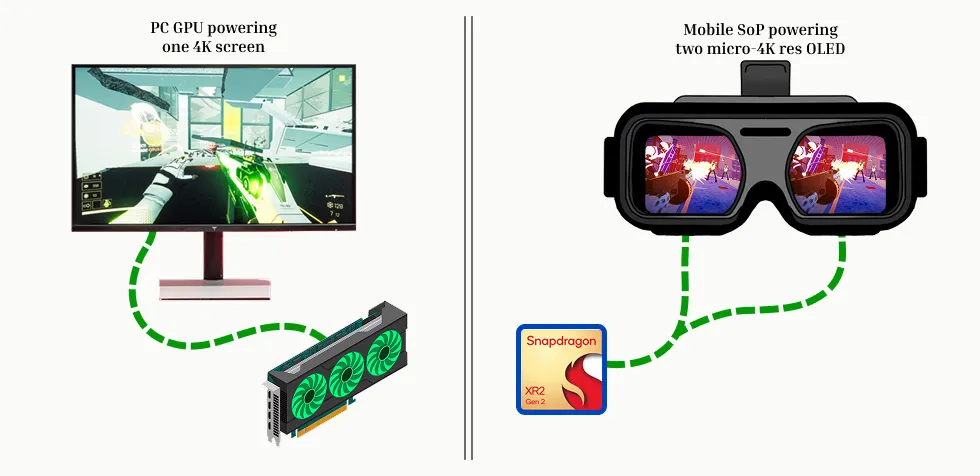
A standalone headset must drive two independent stereo displays simultaneously at 72–120 FPS within a combined 220° field of view, all from a mobile chip with strict power and thermal limits.
“Low-fidelity PC games like Minecraft and Roblox consistently outperform high-fidelity standalone VR in session duration. If graphical power determined immersion, this would be impossible.”
Research premise, informed by Jin (2024) and Slater & Wilbur (1997)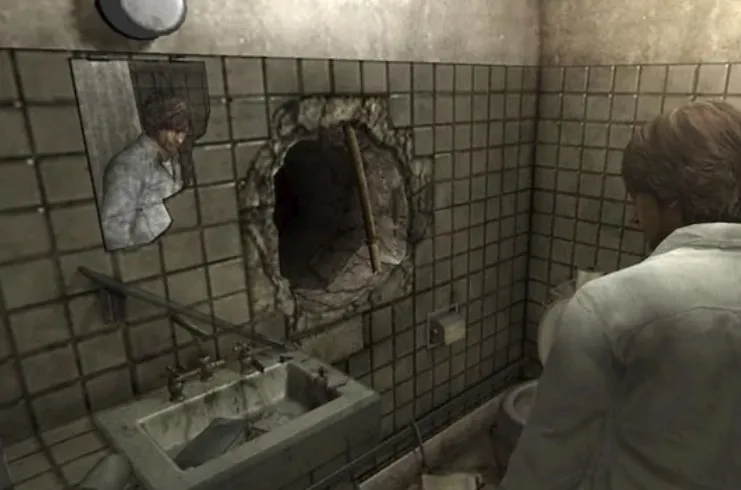
Engagement via atmosphere, not graphical fidelity.
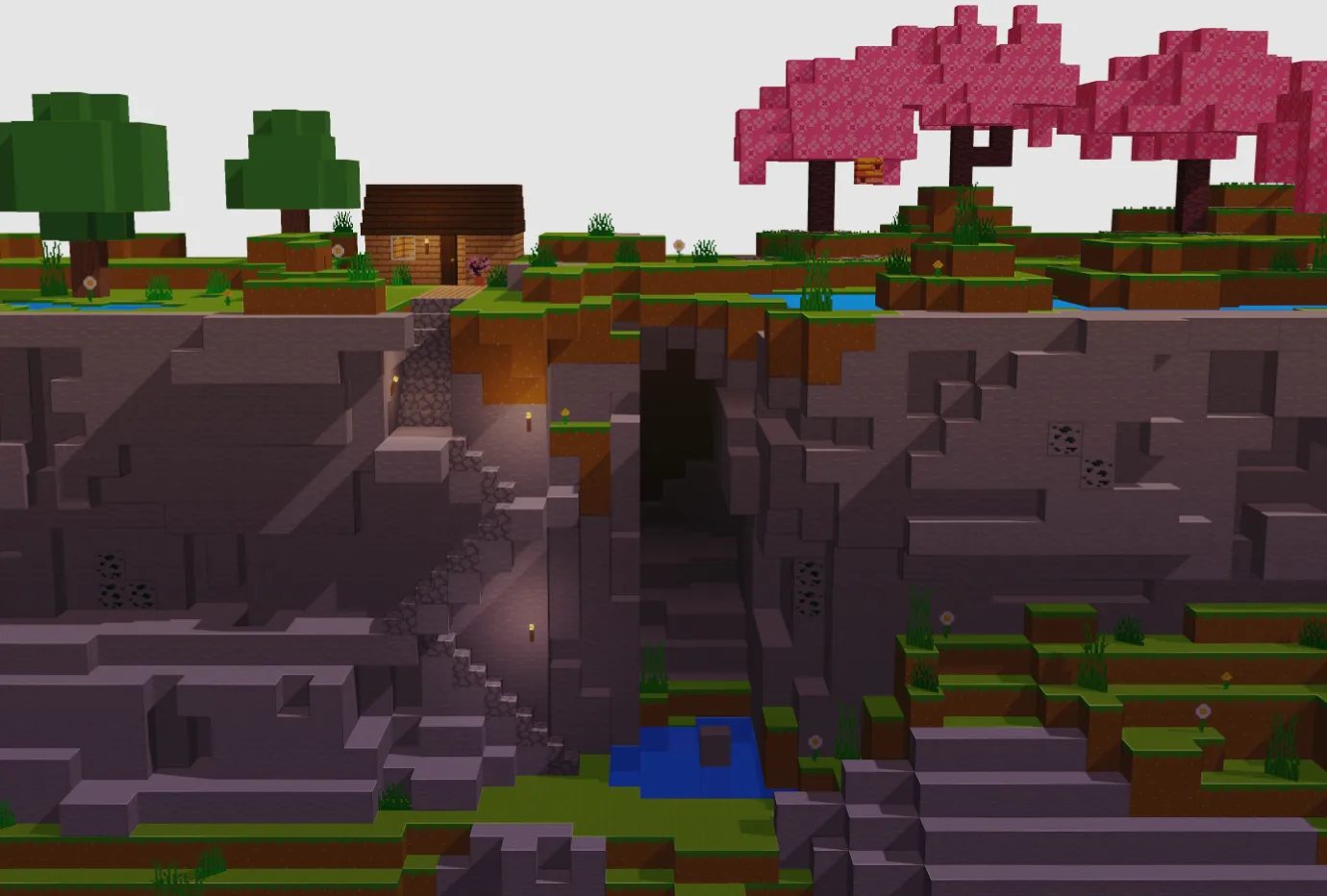
World-record engagement on minimum graphical budget.
The Inherited Paradigm
Why 2D Animation Logic Fails in VR
Standalone VR inherited its animation approach from 40 years of 2D screen game development: keyframed loops, repeating cycles, fixed timelines. On a monitor, cameras cut and shift before the patterns become obvious. In VR, there's no controlled camera. Everything is always visible.
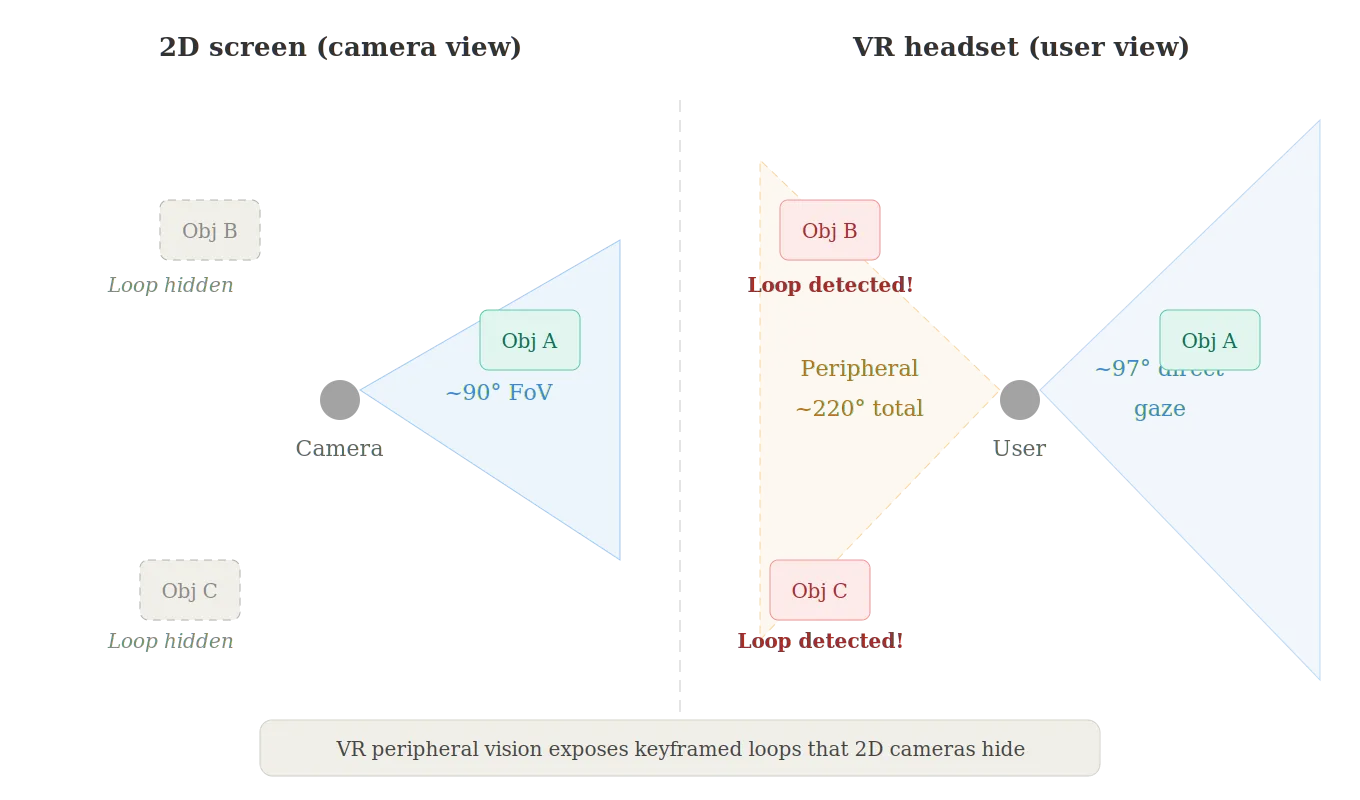
Fig. 1.1: Field of View Comparison, 2D Camera vs. VR User · VR's expanded peripheral FoV (~220°) exposes keyframed loops that 2D cameras hide
Key Insights
What the Problem Analysis Revealed
Standalone headsets are genuinely constrained: two stereo displays at 72–120 FPS from a mobile chip doesn't leave much room to work with. But the response from developers has mostly been to push for more graphics power, which isn't the right fix. Low-fidelity games like Minecraft consistently beat high-fidelity standalone VR in session length. The constraint is being framed wrong.
Keyframed animation loops work on 2D screens because camera cuts and framing keep them hidden. VR's ~220° field of view removes that cover. The same loop that's invisible on a monitor becomes a noticeable, presence-breaking artefact in VR. That's a design problem, not a hardware problem.
The key insight from Slater and Wilbur is that immersion and presence are different things. Immersion is about hardware. Presence, the feeling of actually being in the space, can be improved through environmental responsiveness at very low computational cost. That shifts the whole problem.
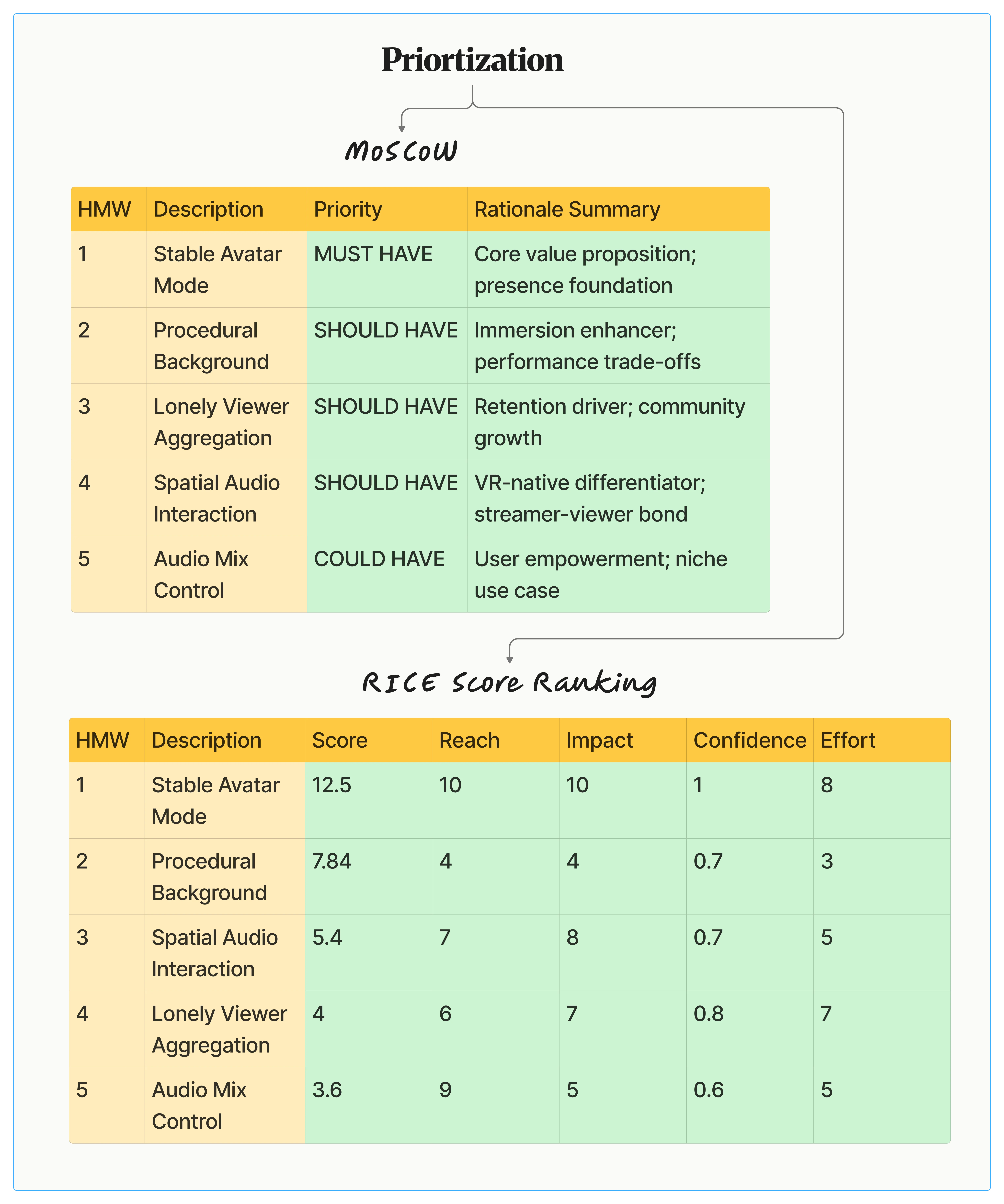
Prioritisation Matrix: comparing problems across user impact, feasibility of intervention, and developer control
Research Direction
Reframing the Question
Rather than pursuing graphical fidelity (an arms race standalone hardware cannot win), this research asks whether environments that respond dynamically to user presence can sustain immersion more effectively.
Slater and Wilbur (1997) draw a key distinction: immersion is a technical property (resolution, FoV, tracking latency), while presence is a subjective experience that can be optimised independently of hardware.
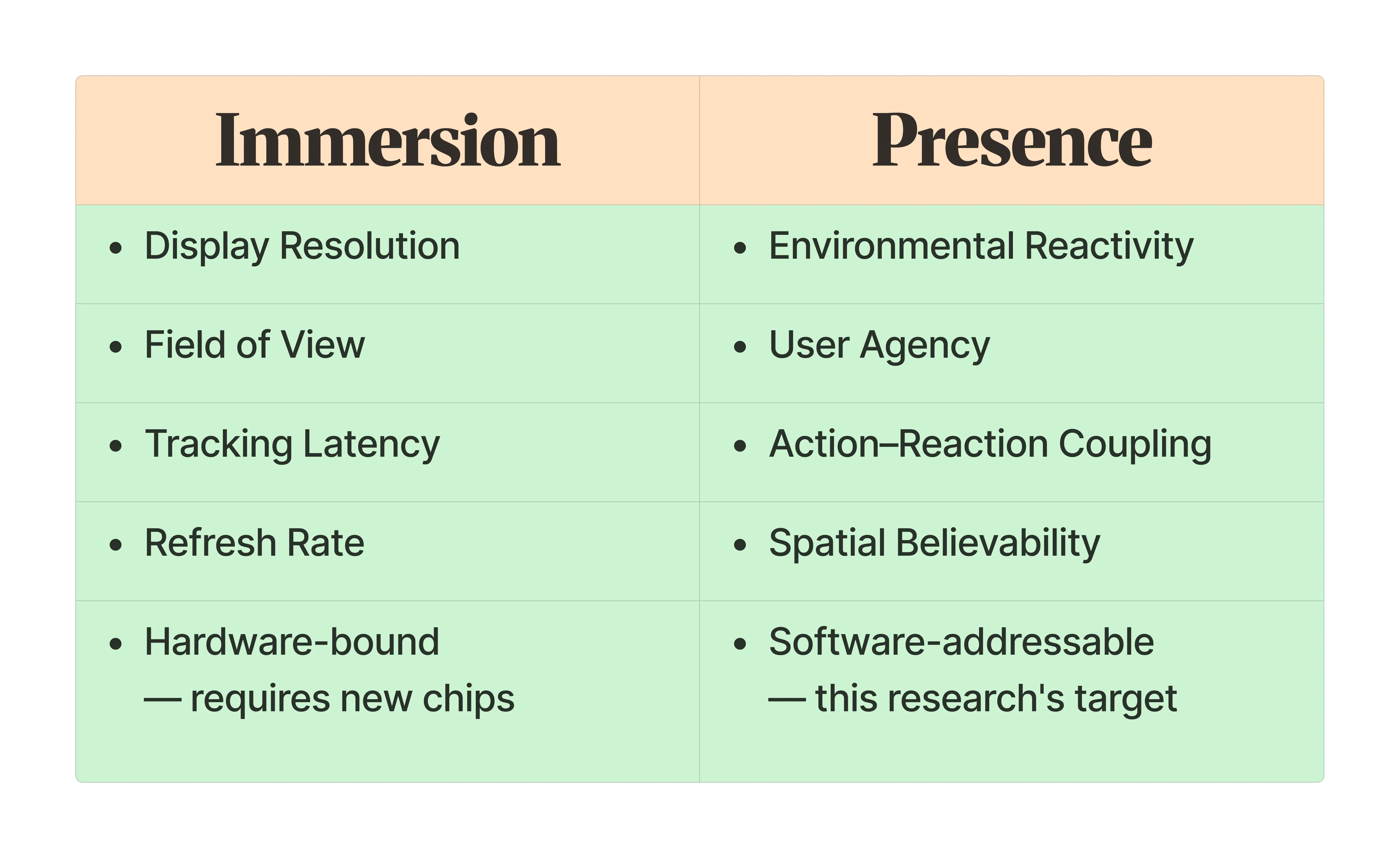
Presence vs. Immersion Framework · Slater & Wilbur (1997); Jin (2024); Kelsey et al. (2023)
Design a hardware-efficient procedural animation pipeline for standalone VR, maintaining minimum 72 FPS under all interaction conditions on Meta Quest 2.
Conduct a controlled A/B study comparing session duration, interaction frequency, and self-reported immersion between static-animation and user-reactive conditions.
Measure whether diegetic vs. non-diegetic onboarding affects first-time users' ability to engage with the reactive systems at all.
Methodology
Four-Phase Research Process
The methodology was iterative by necessity. Any technique dropping frame rate below 72 FPS on standalone hardware triggers motion sickness, making the experience unusable as a research instrument.
Audio-Reactive Pipeline: TouchDesigner → Unity
TouchDesigner was linked to Unity via NDI/Spout/OSC protocols. Live audio was decomposed via FFT into spectral frequency bands that drove Unity shader parameters and mesh vertex displacements in real time: bass controlled torch flicker intensity, mid-frequencies drove particle emission, highs drove colour modulation.
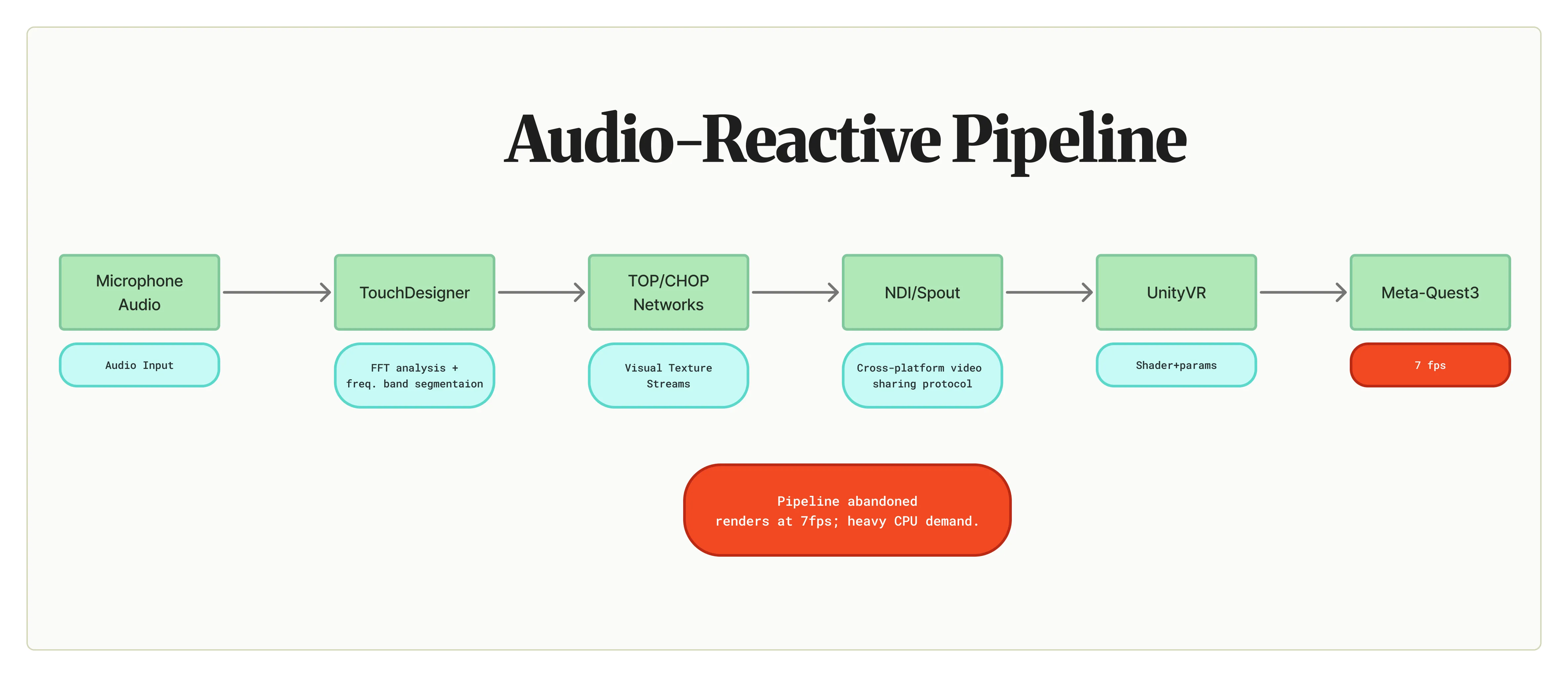
Fig. 4.1: Audio-Reactive Pipeline Architecture (Abandoned) · TouchDesigner → NDI/Spout/OSC → Unity VR → Meta Quest 2: 15–35 FPS
Abandoned. Meta Quest 2 output: 15–35 FPS. Inter-application GPU texture sharing and audio-driven physics consumed the entire processing budget.
Principle retained. Dynamic environmental responsiveness is the correct direction. Scale of computation must be reduced dramatically for standalone deployment.
The Prison Room, Native Unity URP
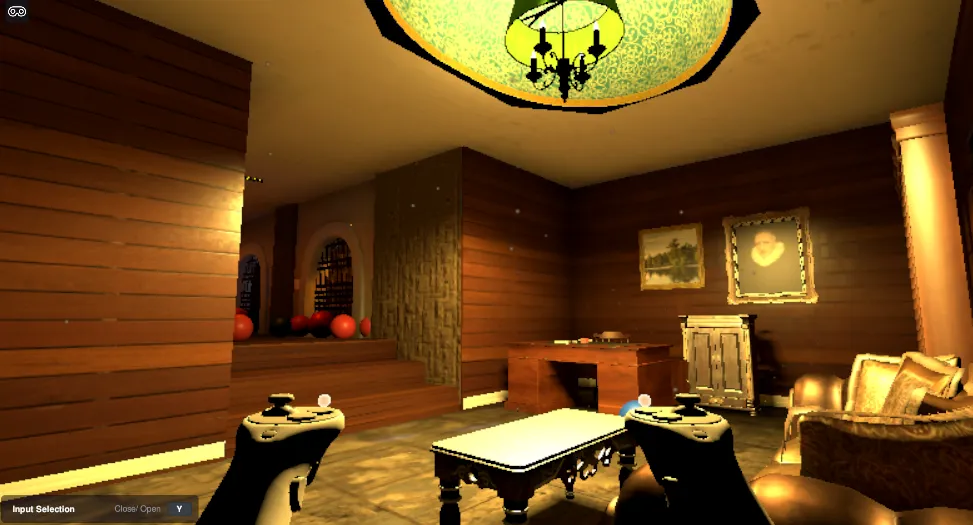
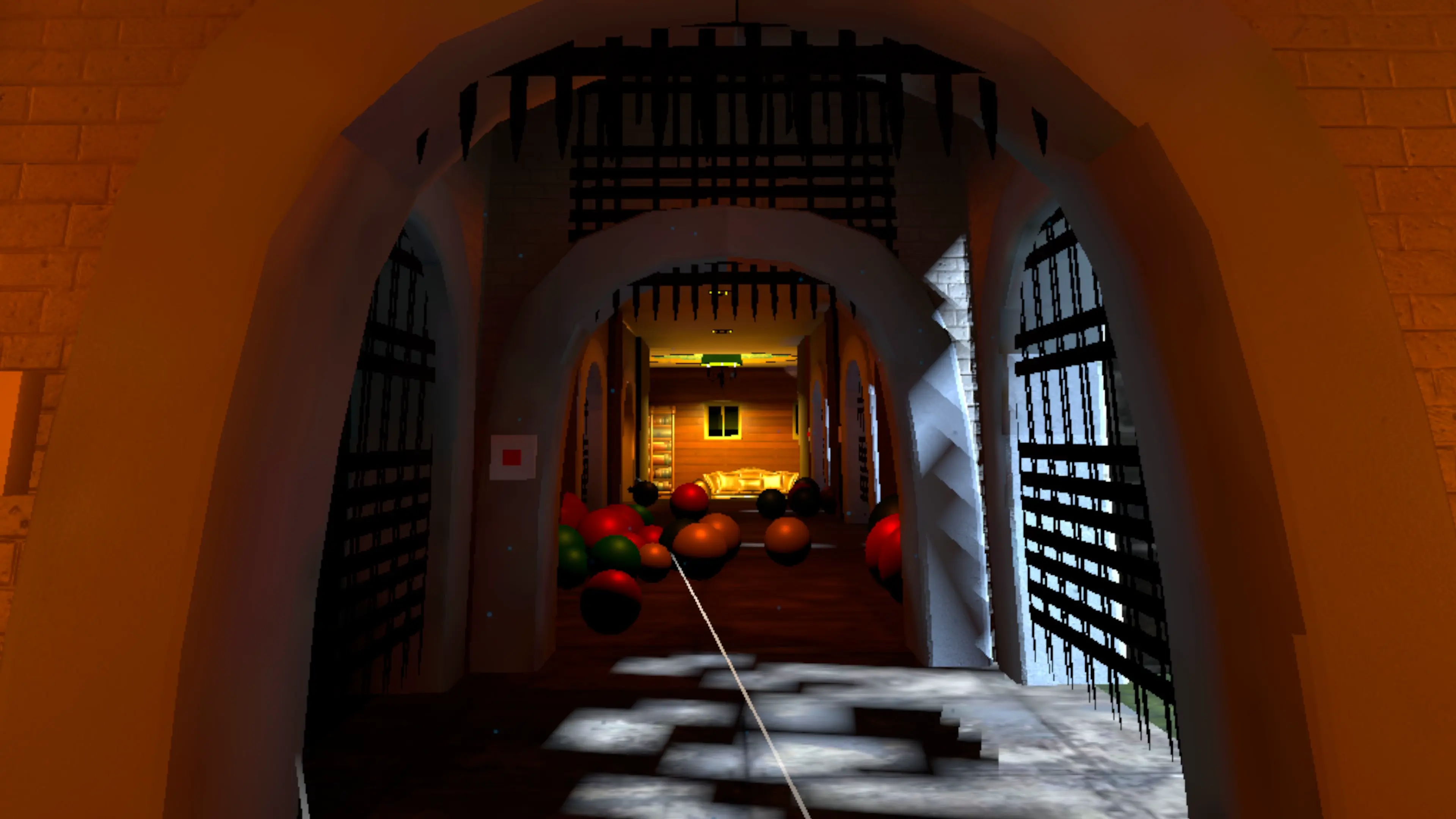
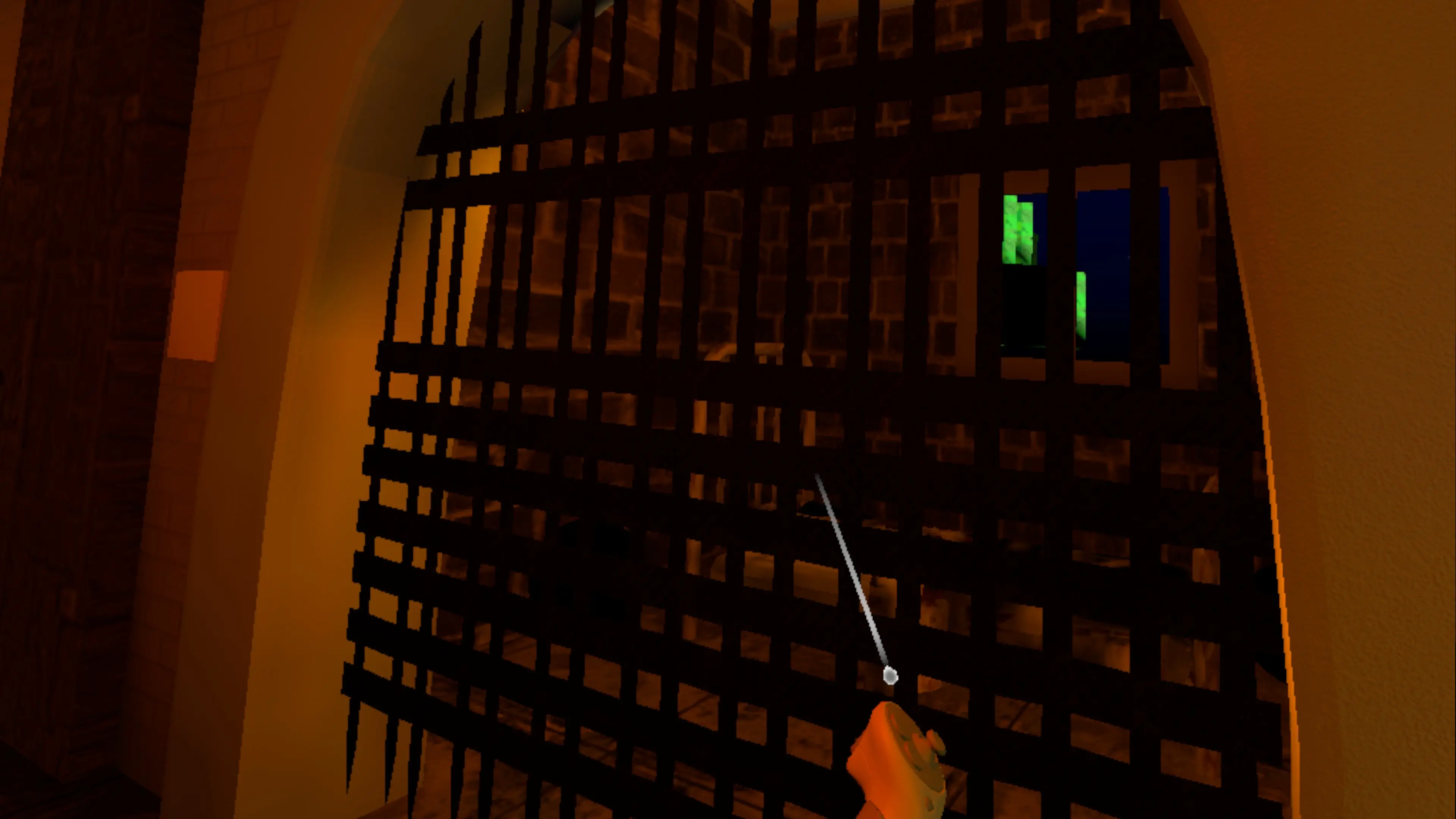
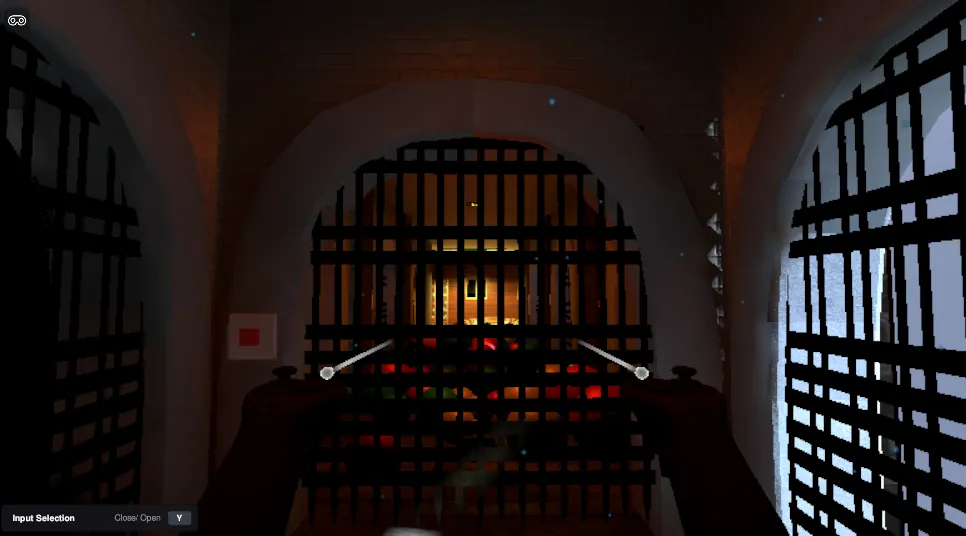
A purpose-built test environment called the “Prison Room,” designed in native Unity URP. Three interconnected zones: entry cell with warm torch lighting, central corridor with arched openings, and interior study room with grabbable props.
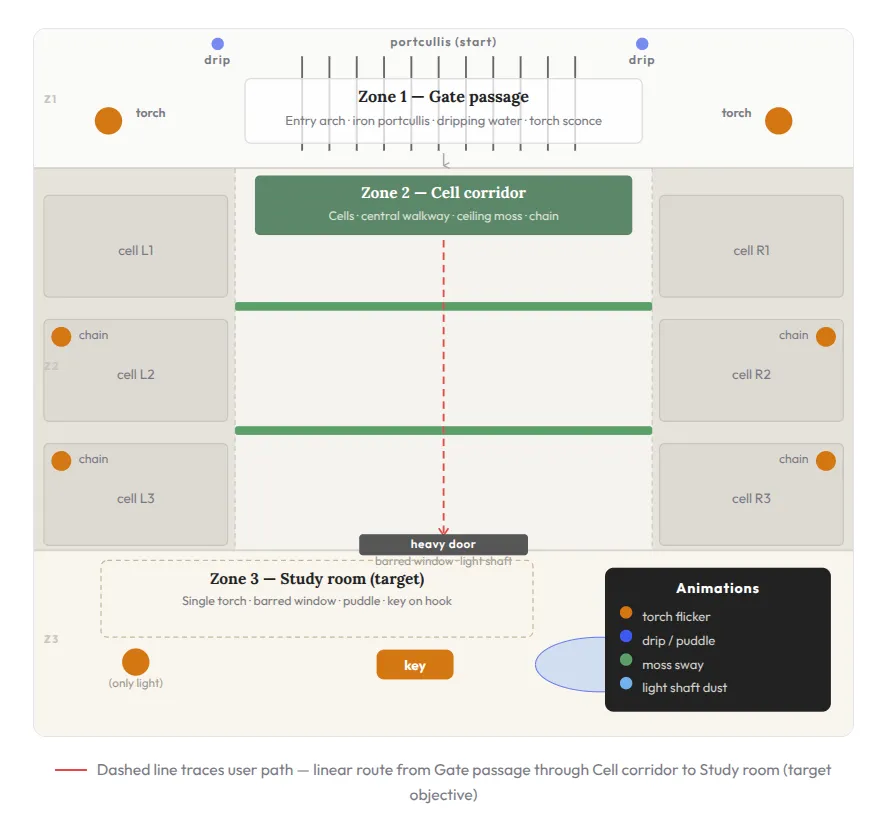
Fig. 4.2: Prison Room, Three-Zone Floor Plan · Zone 1: Entry Cell · Zone 2: Central Corridor · Zone 3: Study Room
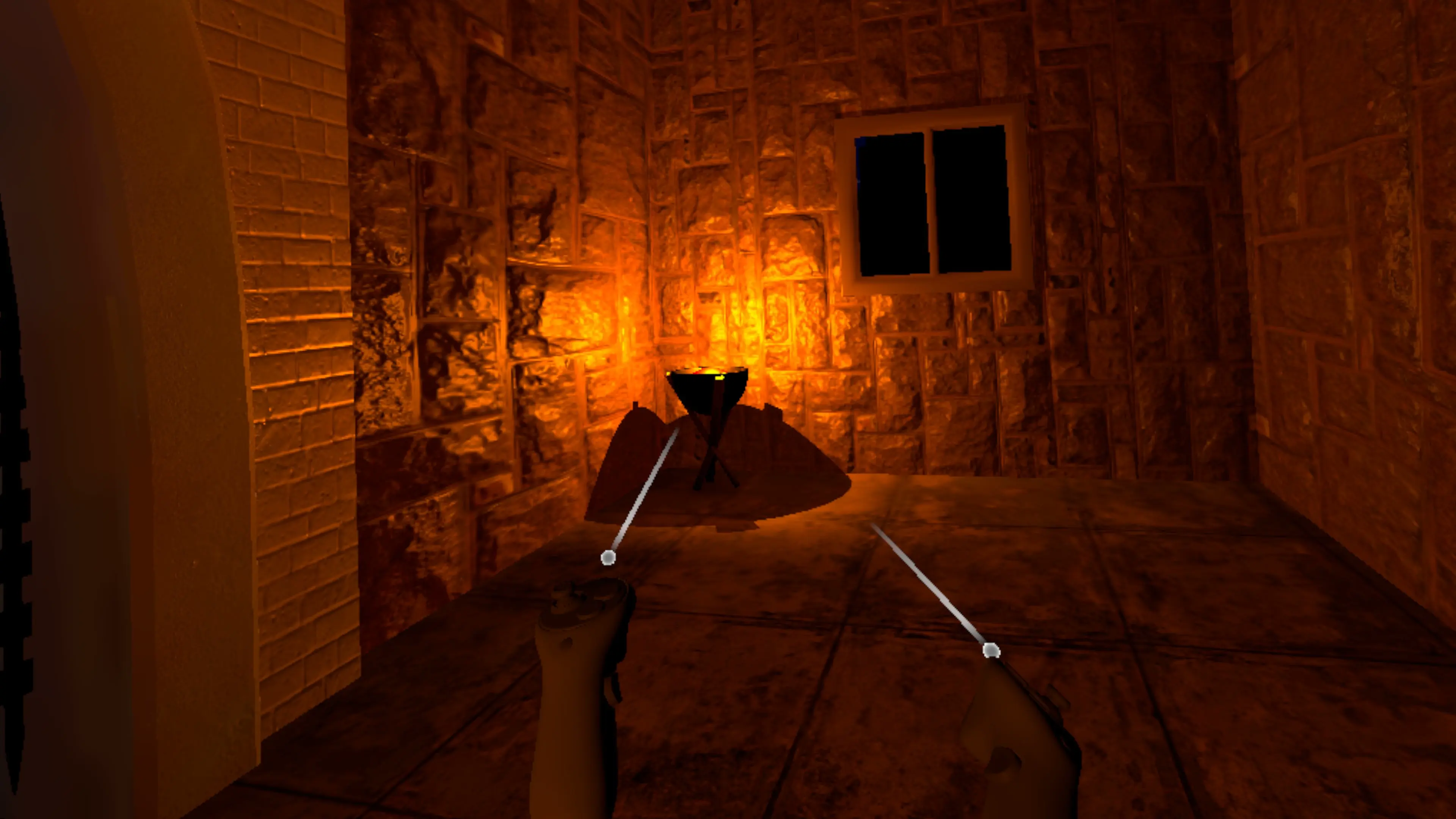
Fig. 4.3: Entry Zone · Zone 1: Torch intensity responds to player approach
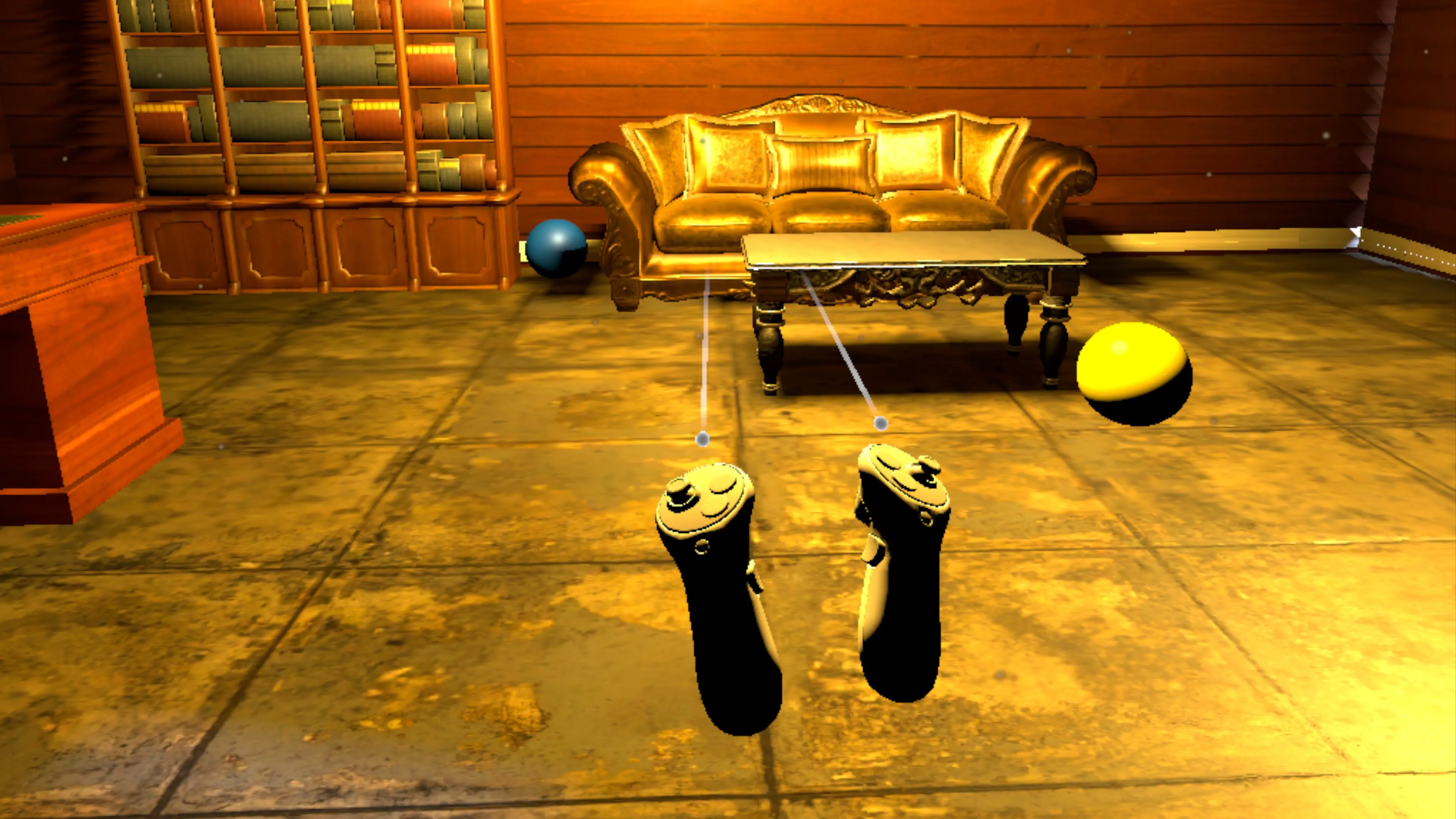
Fig. 4.5: Study Room · Zone 3: Grabbable props trigger proximity effects
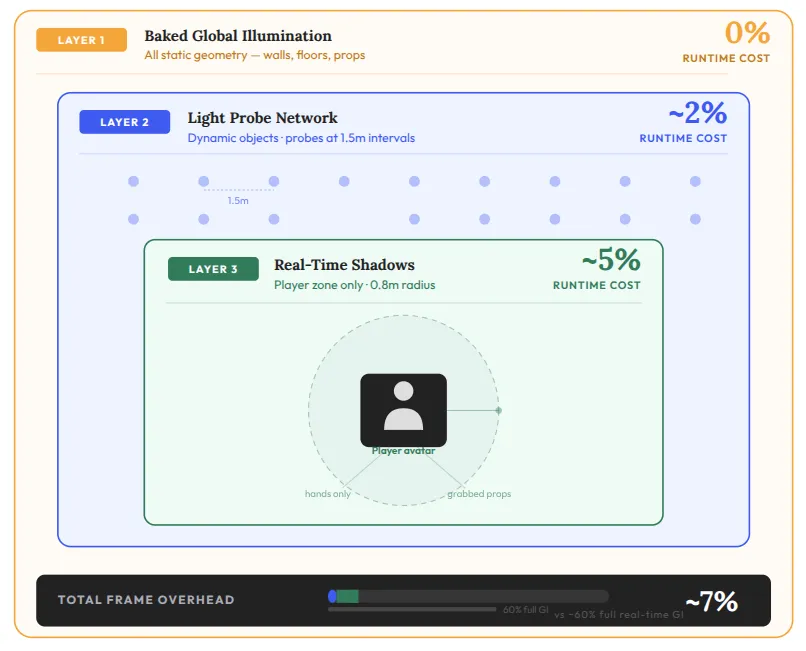
Fig. 4.6: Render Optimisation, Three Nested Layers · Baked GI (~0%) + Light Probe Network (~2%) + Real-Time Shadows in 0.8m player zone (~5%) = ~7% total overhead
Stable 72+ FPS baseline established. Full rendering budget headroom available for procedural animation systems.
Four Primitives. Two Trigger Types.
Four procedural animation primitives implemented in C# within Unity, each triggered by user proximity (Euclidean distance from head transform drops below threshold) or physical interaction (XR controller collider intersects object trigger).
Composite sine waves at randomised frequency and amplitude per object, prevents synchronisation
Mathf.PerlinNoise at time-offset coordinates per particle, producing a unique non-repeating trajectory each frame
Lerp with smoothing coefficient 0.05–0.15/frame, prevents state snapping
Scale and fade based on vertical head delta, simulates disturbance of settled dust
All four primitives deployed. Frame rate maintained at 72+ FPS under all interaction conditions on Meta Quest 2.
8 Participants · Two Conditions · Two Onboarding Types
An A/B testing build deployed on Meta Quest 2 hardware. Eight participants recruited from a student population, ranging from first-time headset users to frequent VR gamers. Each completed sessions in both conditions, with order counterbalanced.
All animations as pre-rendered keyframe loops. No proximity triggers active.
All four procedural systems fully active, responding to real-time user proximity and controller input.
User Study Recording
Task-Driven Session: Did the Environment Feel Alive?
Participants were given a single objective: find the key and escape the cell. The session captures navigation pattern, zone dwell time, and whether users voluntarily return to areas already visited.
Findings
What the Data Shows
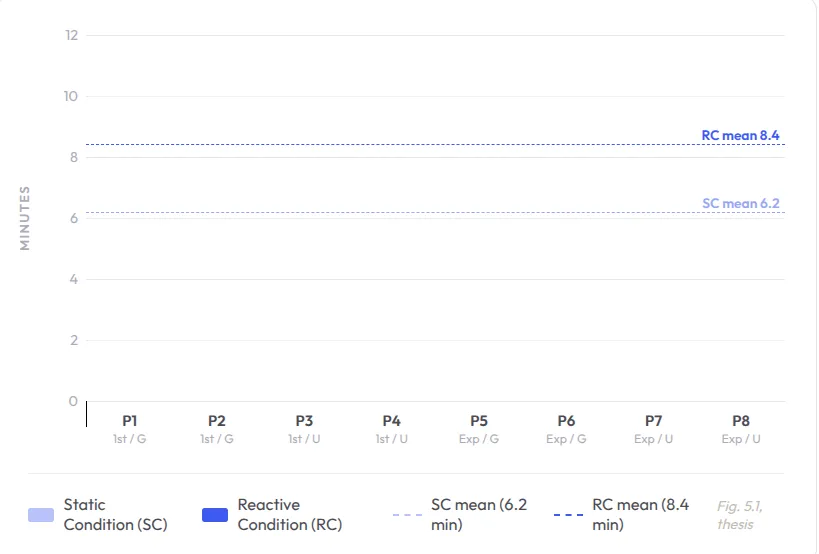
Fig. 5.1: Session Duration by Participant, Static vs. Reactive Condition · RC mean 8.4 min vs. SC mean 6.2 min (+35%)
In the static condition, participants visited each zone once and moved on. In the reactive condition, they returned an average of 3.75 times per session to re-trigger effects they'd already discovered. That kind of voluntary re-engagement didn't happen at all in the static version. It's probably the clearest behavioural signal that presence was working.
Experienced VR users noticed the responsive systems within the first two minutes and deliberately went back to explore what they'd triggered. First-time users didn't consciously report noticing the reactivity at all. But they still explored more, stayed longer, and triggered more events than they did in the static version.
Reaching toward the brazier and seeing the torch respond felt completely different from watching the same flame on a timer. One feels like the environment is aware of you. The other is just decoration. This lines up with Beacco's framework: presence comes from action-reaction coupling, not from visual complexity.
Environment Gallery
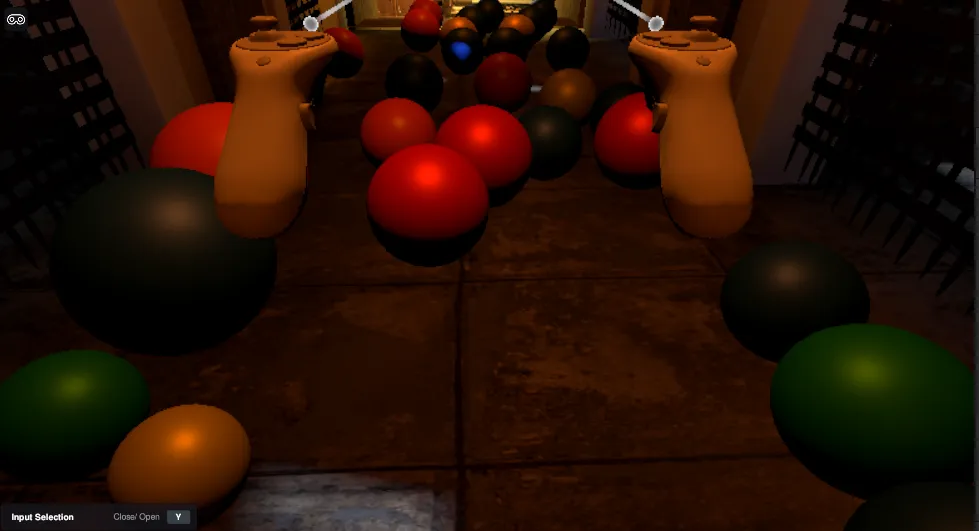
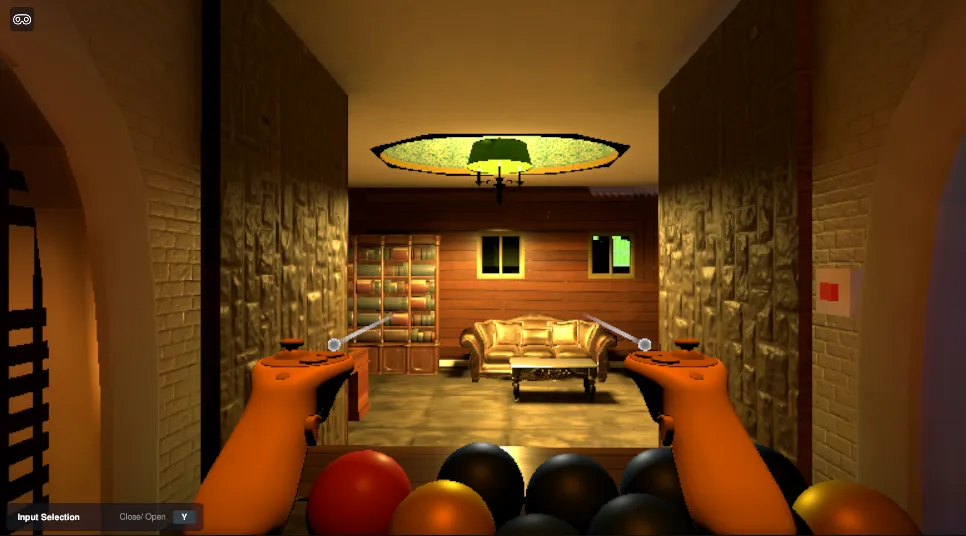
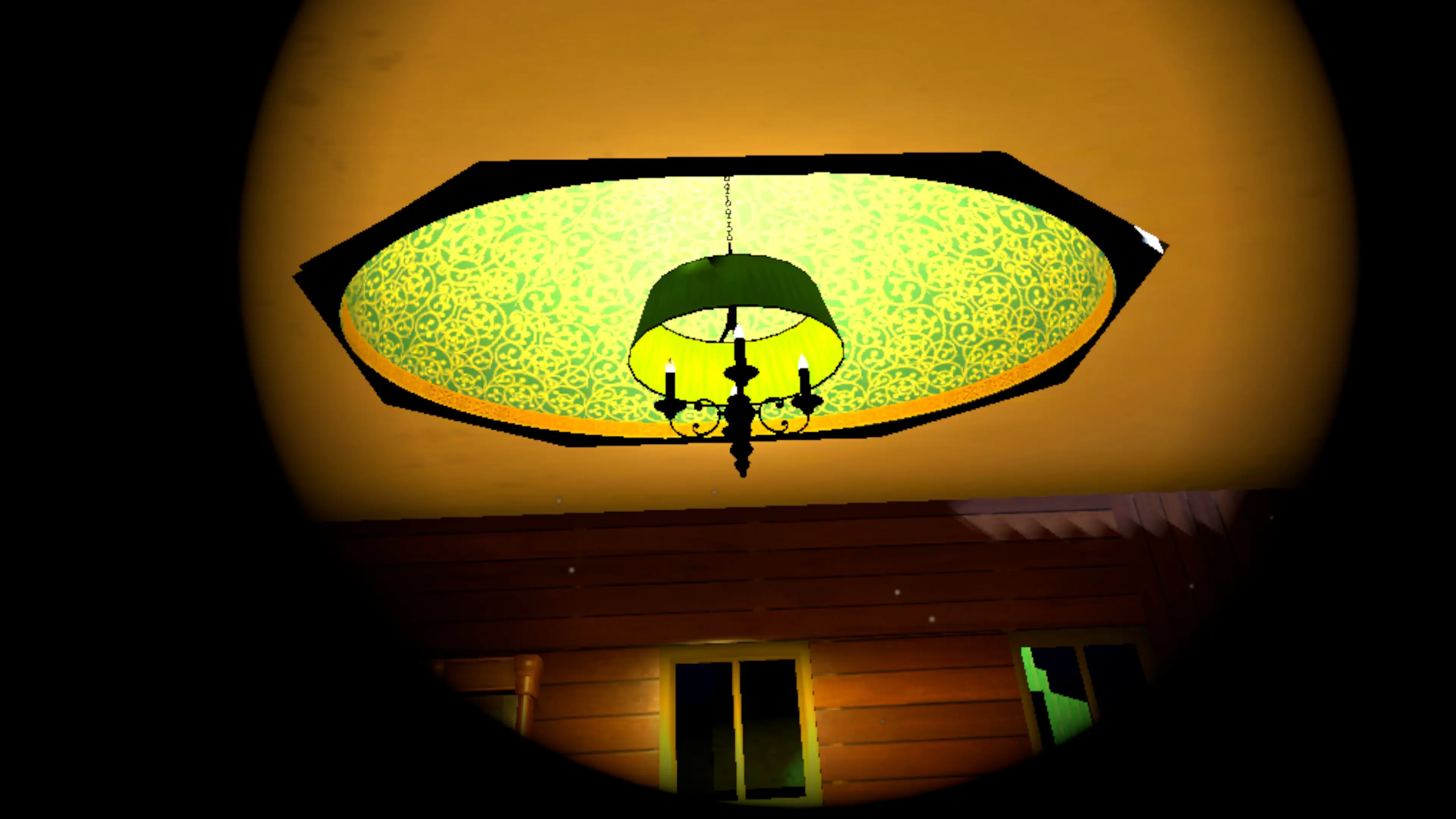
The Prison Room in Unity.
Conclusion
Environmental responsiveness over graphical power.
On constrained standalone hardware, making environments responsive to user presence is more effective than pushing for better graphics. What's interesting is that the same procedural system works at two different cognitive levels: experienced users consciously noticed and explored the reactions, while first-time users stayed longer and engaged more without ever reporting why.